Brand consistency is straightforward in theory.
There is a logo. There are approved colors. There are guidelines. There are templates. Everyone uses the current versions.
In practice, it rarely works that way.
A brand team can spend weeks approving a new logo, refreshing a color palette, or updating its guidelines. The final assets are distributed across the organization, and almost immediately the old versions begin appearing again.
A regional office has the previous logo saved locally. A franchise partner is using an older template. Someone in a sales team has a folder containing assets that were correct two years ago.
Nobody is deliberately breaking the rules.
The problem is that static files do not update themselves.
Brand consistency becomes a distribution problem
The larger an organization becomes, the harder this gets.
A single location can manage a relatively small collection of assets. Add dozens of offices, franchises, sales teams, or regional marketing departments, and the number of places where brand assets can exist increases rapidly.
The brand team may know which version is correct.
The rest of the organization may not.
A logo gets downloaded and saved locally. A color gets copied from an old document. A template gets duplicated and modified. A guideline is followed from memory instead of from the latest approved source.
Over time, the organization develops multiple versions of what is supposed to be the same brand.
That is when "brand consistency" starts to look less like a guidelines problem and more like a systems problem.
For print providers, the problem starts even earlier
For a print service provider managing corporate accounts, maintaining an existing brand is only half of the challenge.
The problem often begins when the account is first onboarded.
A new customer may provide a brand guide, several logo files, fonts, color definitions, existing artwork, templates, and a collection of exceptions that have accumulated over time.
Someone has to interpret all of it.
Someone has to determine which assets are approved, which rules matter for production, and how those rules should be reflected in products, templates, and ordering workflows.
That knowledge often ends up distributed across folders, individual templates, account notes, and the experience of the people who originally set everything up.
The result may work.
But the brand itself never really becomes something the system understands.
And when the customer changes its logo, colors, fonts, or rules months later, the same work begins again.
Static guidelines cannot solve a live brand problem
Traditional brand management often focuses on documentation.
Create the guidelines. Distribute the guidelines. Train people on the guidelines. Remind people to follow the guidelines.
But a document can tell people which logo to use without preventing them from using the wrong one.
It also cannot tell a print provider where that logo is currently being used across templates, products, and ordering experiences.
If an outdated logo is still sitting in a shared drive, it remains available.
If an old template is still saved on someone's desktop, it can still be used.
If the current brand color has changed but the old version remains embedded in a workflow, the old version can continue to appear in printed materials.
The challenge is therefore not simply communicating the correct standard.
It is turning the brand from a collection of files and instructions into something that can be managed throughout its lifecycle.
Making the brand operational
That is the idea behind Brand Lifecycle Management in Customer’s Canvas.
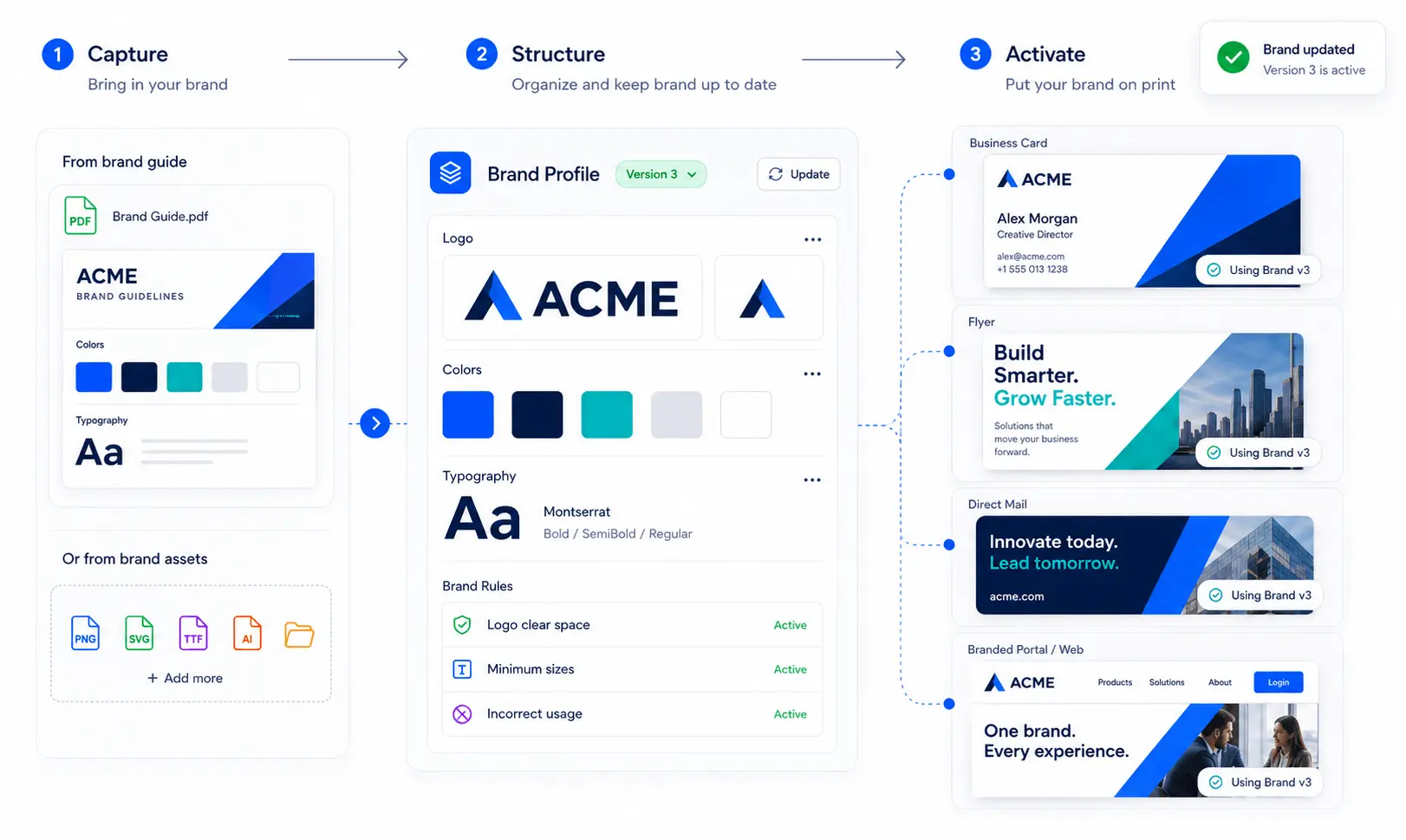
Instead of treating a corporate brand as a PDF brand guide plus a folder of assets, Brand Lifecycle Management creates a structured Brand Profile that can represent the approved elements of the brand and connect them to the resources used in real print workflows.
Logos, colors, fonts, and other brand information can become part of a governed brand state rather than remaining isolated files.
That Brand Profile can then be connected to Customer’s Canvas layouts and the ordering experiences built around them.
The difference is subtle but important.
Instead of rebuilding the same brand knowledge separately inside every template or relying on people to remember which files are current, the system has a defined representation of the brand those workflows are supposed to use.
A brand does not stay still
Onboarding is only the beginning.
Brands change.
A customer introduces a new logo. A color changes. A font is replaced. A regional variation is introduced. An old asset is deprecated.
In a traditional workflow, those changes can become another search-and-update project.
Which assets changed?
Which version is current?
What was used before?
Which templates or resources may need attention?
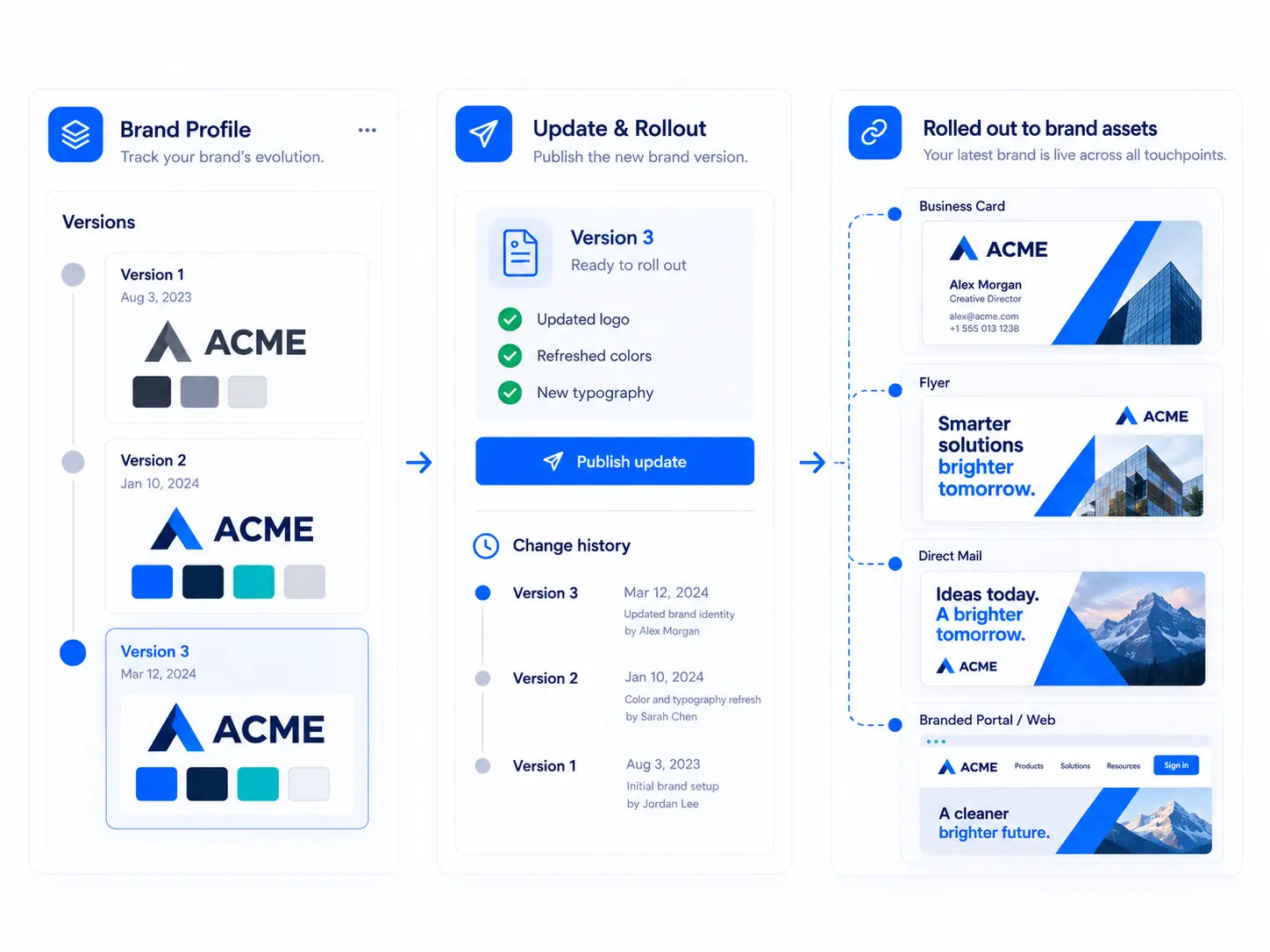
Brand Lifecycle Management is designed around the idea that these changes should be managed as part of the brand itself.
Brand versions make it possible to preserve the previous state while defining what has changed in the next one. Connected resources and layouts provide the foundation for understanding where those changes matter and managing the transition in a controlled way.
The goal is not to make every brand change happen invisibly.
It is to stop treating every brand change as a new manual reconstruction exercise.
The operational cost of getting it wrong
For brand managers, the obvious concern is consistency.
But for print providers, there are operational consequences too.
An outdated logo can mean a reprint.
An incorrect color can trigger a brand review.
A non-compliant piece can delay production.
A customer using an old template can create additional work for account managers, designers, prepress teams, and customer service.
The problem is rarely limited to the person who used the wrong file.
Once an incorrect asset enters a print workflow, the cost of correcting it can spread across multiple teams.
Preventing outdated or incorrect brand information from entering the process in the first place is significantly more efficient than discovering it after production has started.
Better brand control is also better workflow control
For account managers and client services teams, this can eliminate awkward conversations.
Nobody wants to tell a client that their regional office ordered materials using last year's logo.
Nobody wants to explain why a printed piece needs to be re-run because an outdated brand asset was used.
And nobody wants to become the human checkpoint responsible for remembering how every corporate customer's brand was configured.
For production and prepress teams, the benefit is equally practical.
Fewer brand-related corrections mean fewer jobs being pulled, changed, and requeued after they should already have been moving toward production.
Getting brand governance right earlier means production time can remain focused on production.
The infrastructure behind consistency
There is a broader lesson here.
Brand control is often treated as a policy problem.
In a distributed organization, and especially in a print provider managing many corporate brands, it is increasingly an infrastructure problem.
The organizations that maintain consistency at scale are not necessarily the ones with the longest brand guidelines or the most frequent training sessions.
They are the ones that can turn those guidelines into structured, usable brand information and keep that information connected to the workflows that depend on it.
A brand guide is still important.
But the real question is what happens after someone sends you the PDF.
See Brand Lifecycle Management in action
At PRINTING United 2026, Customer’s Canvas will demonstrate Brand Lifecycle Management live.
Visitors will be able to see how brand guidelines and assets can become a structured Brand Profile, how that profile can be connected to real Customer’s Canvas layouts and ordering experiences, and how versioning creates a foundation for managing future brand changes without rebuilding the brand from scratch.
For print service providers managing corporate accounts, in-plants, and teams responsible for branded ordering programs, it is an opportunity to see what happens when brand consistency becomes part of the workflow rather than another manual task.
Because the best time to discover that a brand has changed is before the wrong version gets printed.
See Brand Lifecycle Management live at PRINTING United 2026.Booth C230
customerscanvas.com/company/events/printing-united-26