Ask a print provider where a complex B2B order actually gets stuck, and production is rarely the whole answer.
The presses are ready.
The production team can do the work.
But the order is still moving between people.
A customer needs to update the artwork. An account manager needs clarification. Marketing needs to approve the design. Procurement needs to sign off on the budget. Someone needs to confirm which version is actually ready to print.
Each step may be straightforward.
Together, they can turn a simple reorder into a multi-week process.
The problem with disconnected handoffs
Complex print orders rarely move directly from submission to production.
- There are questions.
- There are changes.
- There are proofs.
- There are approvals.
There may be several versions of the artwork before everyone agrees on the final one.
None of those steps is necessarily difficult in isolation.
The problem is what happens between them.
An updated file arrives by email. Someone forwards it to another department. A new correction is requested. Another version is attached to another message. Someone approves the design, but it is not immediately clear which version they approved.
The work itself is not necessarily difficult.
The workflow is.
Email was never designed to manage this
For many print businesses, email becomes the default infrastructure for handling everything that does not fit neatly into an online ordering flow.
It is familiar.
Everyone has it.
But familiarity does not make it a good system for managing a live print order.
Once an order is spread across email threads, attachments, proofs, messages, and individual inboxes, basic questions become surprisingly difficult to answer.
- Where is the order?
- What is the latest artwork?
- What still needs to be changed?
- Has the customer confirmed this version?
- Has the order been approved?
- Is production waiting for someone, or is the job ready to move forward?
The uncertainty between steps can become almost as expensive as the steps themselves.
Making the order visible
Collaborative Ordering inside Customer’s Canvas is designed to keep this work around one structured order.
Instead of the printer and customer coordinating through disconnected emails and files, they can work around the same live order.
- The customer can be brought into the process when input or changes are required.
- Artwork can be customized within a controlled workflow.
- A specific version can be confirmed.
- The printer can review the result before the order moves forward.
- The production-ready output remains connected to the process that created it.
The order becomes the shared workspace.
Not just a record of what was purchased, but the place where the work around that order happens.
Visibility matters as much as speed
It is easy to frame workflow automation purely as a speed problem.
Faster turnaround is obviously valuable.
But visibility may be just as important.
An order that takes two days to resolve is manageable if everyone knows what is happening.
An order that sits somewhere for two days with nobody knowing whether the customer, account manager, marketing team, or production team needs to act creates uncertainty.
People follow up.
They send additional emails.
They ask for files that someone has already sent.
They duplicate work.
They escalate unnecessarily.
A structured workflow can reduce that uncertainty even before it reduces the actual turnaround time.
Some orders were never meant to be fully self-service
Web-to-print works extremely well when the ordering process is predictable.
- Choose a product.
- Customize it.
- Place the order.
- Send it to production.
But not every B2B print order works that way.
Some orders require discussion.
Some require customer changes after submission.
Some involve several stakeholders.
Some need an account manager or production team to review the result before it can move forward.
Trying to force every one of those orders into a completely self-service experience does not remove the complexity.
It often just pushes the complexity somewhere else.
Usually into email.
The better approach is to keep the digital workflow intact even when collaboration is required.
The bigger the operation, the bigger the coordination problem
A difficult order handled by one account manager may be inconvenient.
The same process repeated across dozens of customers, locations, departments, or franchisees becomes an operational problem.
If every complex order is managed through its own combination of inboxes, attachments, shared folders, spreadsheets, and personal follow-ups, improving the process one order at a time is difficult.
A platform-level workflow provides a different approach.
Create a consistent process for how customers and employees work together around an order, then apply it across the organization.
That becomes particularly important for print providers serving corporate customers, distributed teams, franchise networks, or other organizations where several people may need to participate before production can begin.
One order should have one source of truth
The real value of a collaborative workflow is not simply that people can approve something online.
It is that the order, artwork, changes, versions, decisions, and production handoff stay connected.
That matters because many of the problems in complex print ordering come from fragmentation.
One person has the latest PDF.
Another has the approval email.
A third has the customer’s correction request.
Production has a file, but is not completely sure whether it is the final one.
A shared order gives everyone a clearer reference point:
- What is being ordered.
- What has changed.
- What has been confirmed.
- What is ready to happen next.
Moving from handoffs to workflow
The broader shift is from managing complex print orders as a collection of conversations to managing them as structured processes.
That distinction matters.
- A conversation depends on people remembering what happened. A workflow records what happened.
- A conversation requires someone to ask what happens next. A workflow can show it.
- A file in an inbox can quickly become one version among many. A shared order keeps the current state connected to the work around it.
- A conversation can disappear into email. A workflow gives the printer and customer a shared view of the order.
For print businesses handling large volumes of B2B work, that difference can become significant.
See Collaborative Ordering in action
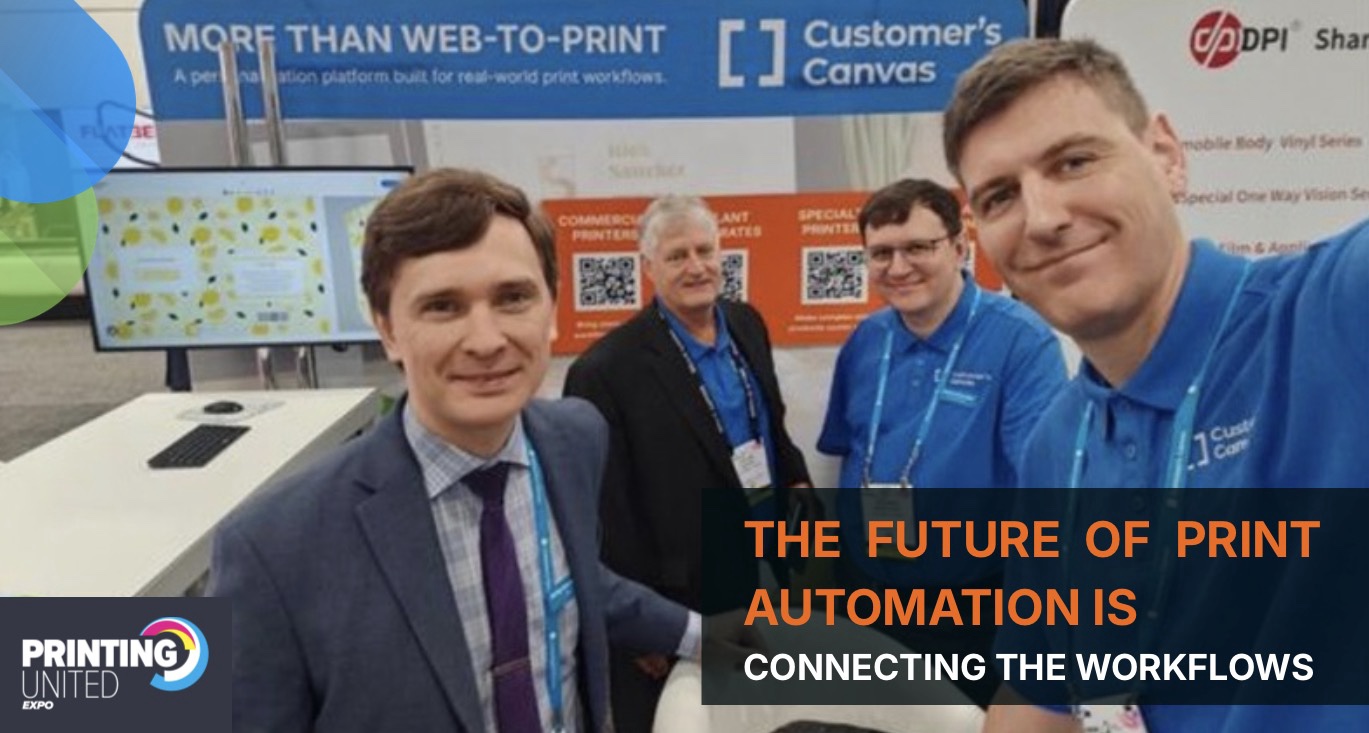
At PRINTING United 2026, Customer’s Canvas will demonstrate Collaborative Ordering live.
We will show a complex B2B print order moving from the initial request through customer changes, version confirmation, review, approval, and production-ready output.
Instead of switching between email threads, attachments, proofs, and manual follow-ups, the printer and customer work around one shared order.
For print business owners, operations teams, account managers, and organizations managing complex B2B print workflows, it is an opportunity to see what happens when collaboration becomes part of the ordering process rather than something that happens outside it.
Because when a print order takes weeks to reach production, the question is not always why production is slow.
Sometimes, the real bottleneck is everything that has to happen before production can even begin.
See Collaborative Ordering live at PRINTING United 2026.Booth C230
customerscanvas.com/company/events/printing-united-26