Premium finishing sells.
Digital foil, spot UV, raised gloss, and other embellishment effects can turn an ordinary printed piece into something that looks and feels significantly more premium.
Customers understand the value.
The problem is how often they still have to access it.
A buyer can configure a custom print job online, personalize a design, upload artwork, choose specifications, and see an instant price.
Then they ask for foil.
Suddenly, the self-service experience stops.
There is a phone call. A conversation about specifications. A quote. A wait. Then another conversation before anyone knows whether the customer is ready to place the order.
For a process that has become increasingly digital everywhere else, that is an unusual bottleneck.
The quote is becoming the barrier
Self-service print ordering has trained customers to expect speed.
They can select a product and configure it online. They can personalize a design or upload their artwork. They can receive pricing quickly.
The moment a premium finishing option requires a manual quote, however, the customer leaves that experience.
That creates friction at precisely the point where a customer is deciding whether to spend more.
And friction has consequences.
A customer who would have said yes to an instantly priced embellishment option may not want to wait for a callback.
Another may decide the process is too complicated.
Another may simply move on to a competitor offering a faster route to the same result.
The print business may never know that the demand existed.
Bringing embellishment into self-service
Digital Embellishment in Customer’s Canvas is designed to close that gap.
Instead of treating premium finishing as a separate manual sales process, it brings embellishment into the same personalization and ordering experience as the printed product itself.
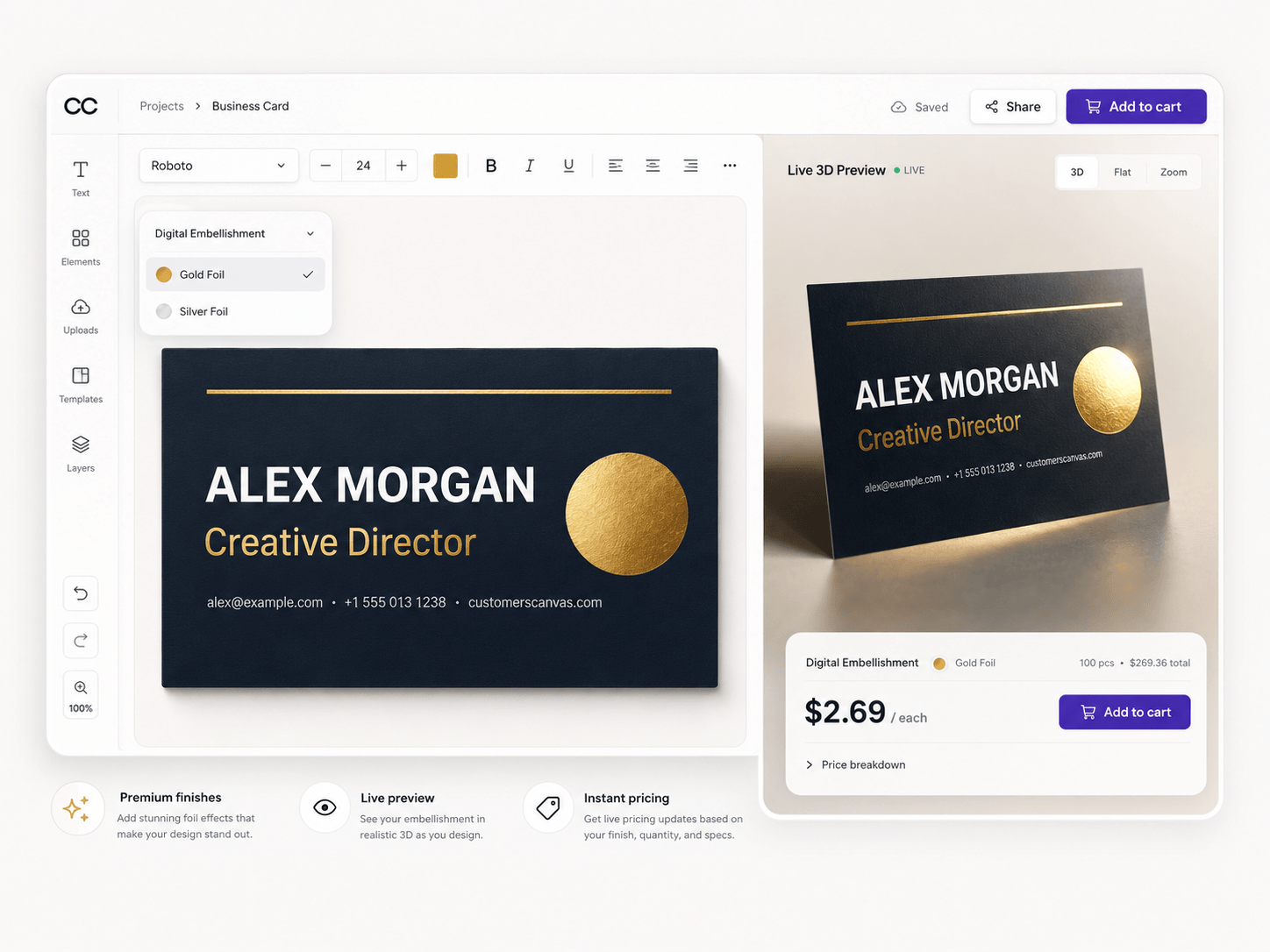
A customer can choose an available effect, apply it to elements of the design, and see how that effect changes the finished piece in a live 3D preview.
Pricing can respond to the design as well.
The amount of finished area, the selected effect, the quantity, setup costs, and other rules defined by the print provider can all become inputs to the price shown during configuration.
That changes the proposition.
The customer does not need to stop and ask what the finish might cost.
They can see the effect, understand the price, and make the decision while they are still configuring the product.
The preview is part of the sales experience
Premium finishing is inherently visual and tactile.
That makes it difficult to sell through a simple checkbox.
“Add foil” means much less to a buyer than seeing which parts of their actual design will become metallic, glossy, or raised.
A realistic preview helps bridge that gap.
It gives customers a better understanding of what they are buying before the job reaches production and gives print providers a way to present higher-value options directly inside the ordering experience.
The 3D preview is not the goal by itself.
It is what helps turn a production capability into something a customer can understand and buy online.
More than convenience
The obvious benefit is a better customer experience.
But for print businesses, the commercial opportunity is more significant.
Every manual quote introduces a potential drop-off point.
The customer has to make another contact. Someone has to respond. Someone has to calculate or confirm the price. The customer has to wait.
For large, complex, highly customized embellishment work, that sales interaction may be entirely appropriate.
But not every embellishment job is complex.
There is a large category of repeatable work where the available effects, product constraints, and pricing rules can be defined in advance.
Making that work available through self-service can open the door to demand that previously never entered the funnel.
Turning premium finishing into an option
There is a psychological difference between asking a customer whether they want to request a premium finish and simply making that finish available as part of the product.
When the customer can see what foil or spot UV looks like, configure it, and understand the price immediately, the decision becomes part of the normal purchasing process.
The embellishment is no longer a special request.
It becomes another configurable part of the product.
That is an important shift for print businesses looking to increase the value of online orders.
Personalization does not have to stop when finishing begins
There is another opportunity that becomes possible when personalization and embellishment live in the same workflow.
Premium finishing does not have to be limited to one static design.
A print provider can combine variable customer data with a product that includes foil, spot UV, or other configured effects.
For repeatable products and bulk orders, names, text, or other variable content can change from record to record while the finishing setup remains part of the same product definition.
That opens the door to personalized premium products without turning every variation into a separate manual job.
A cleaner path toward production
There is also a production-side benefit.
An order created through a structured digital workflow can carry more than a verbal instruction that “this part should be foil.”
The design itself identifies where the finishing effect belongs, while the product configuration provides the surrounding information needed to price and process the job.
That creates a much clearer handoff than specifications assembled from emails, notes, and phone conversations.
The exact production output still depends on the finishing technology and the requirements of the connected equipment or workflow.
That distinction matters.
Customer’s Canvas provides a personalization and commerce layer that can represent the customer’s finishing intent and carry it forward. Device-specific production requirements can then be handled through the appropriate OEM or production integration.
This does not eliminate relationship-based selling
Digital self-service should not be confused with a replacement for sales expertise.
There will always be projects where customers benefit from talking to someone who understands the equipment, materials, finishing capabilities, and production constraints.
Large or unusual embellishment jobs may require exactly that level of consultation.
The opportunity is to remove unnecessary manual intervention from the work that does not need it.
If a repeat customer wants a familiar product with a standard foil option, they should not necessarily have to start a quote conversation every time.
The bigger opportunity for print businesses
The real opportunity is not simply to make ordering easier.
It is to make more of the available production capability commercially accessible.
A print business may already have the equipment, finishing partners, and expertise to produce premium work.
But if customers cannot easily discover, visualize, configure, personalize, and price those options online, much of that capability remains behind a manual sales process.
Digital Embellishment brings more of that capability into the digital ordering experience.
That can help print businesses turn premium finishing from a specialist request into a more accessible part of the product mix and create a stronger commercial path from personalization to production.
See Digital Embellishment at PRINTING United
At PRINTING United 2026, Customer’s Canvas will demonstrate Digital Embellishment live.
Visitors will be able to see a personalized product with digital finishing, apply different effects, inspect the result in 3D, see pricing respond to finishing coverage and order quantity, and explore how the same approach can extend to bulk personalized orders.
We will also show the role of Customer’s Canvas as a vendor-neutral personalization layer and discuss how it can connect with different finishing technologies and OEM workflows.
For print shop owners, ecommerce and product teams, sales leaders, and production teams, the question is straightforward:
How much more premium finishing could you sell if customers could see it, personalize it, and price it without leaving the online order?
See Digital Embellishment live at PRINTING United 2026.Booth C230
customerscanvas.com/company/events/printing-united-26