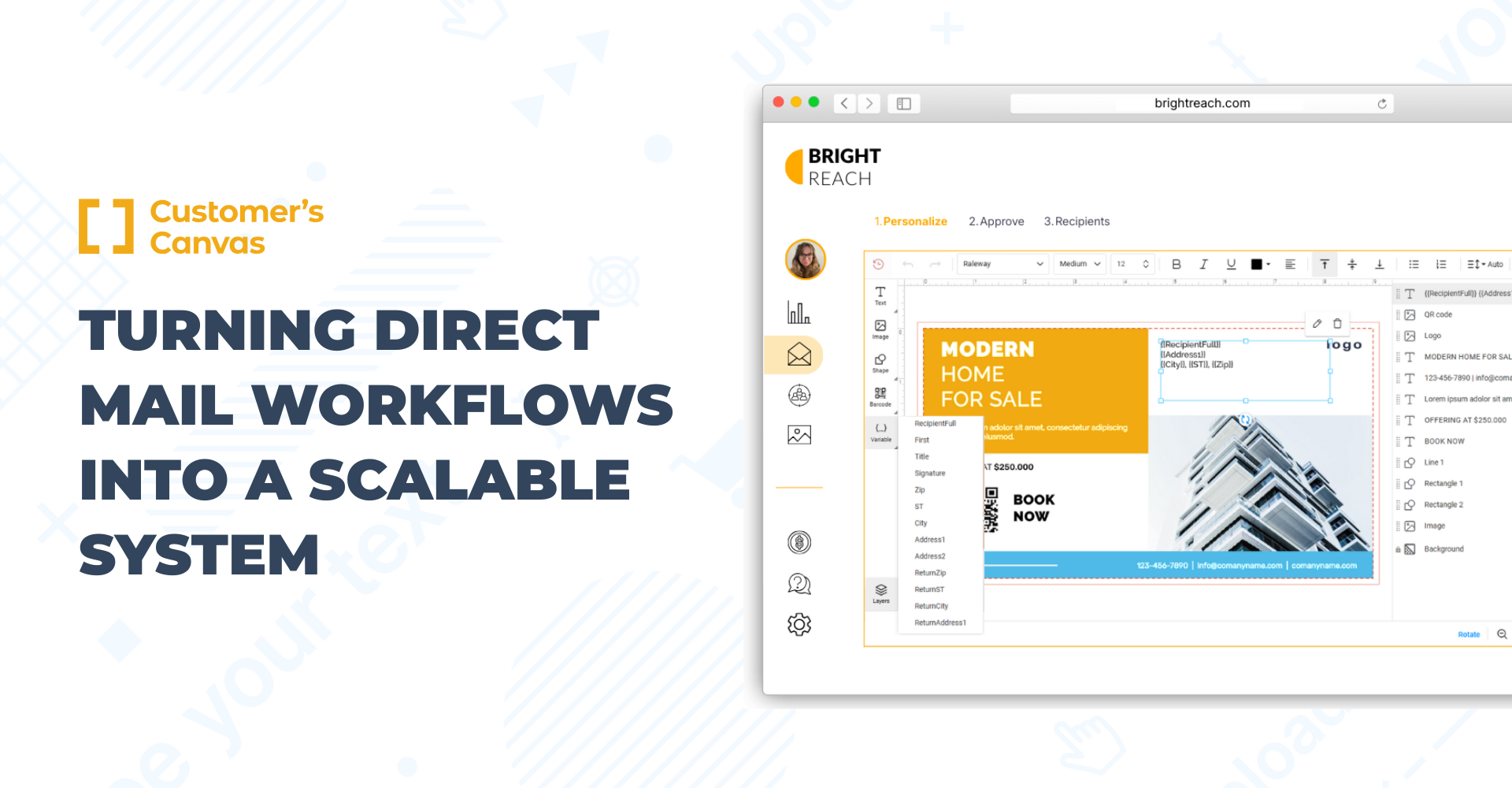
/Blog%20cover%20(9).png)
Direct mail has been around for decades, but it’s undergoing a quiet transformation. Modern businesses that rely on personalized outreach, from appointment reminders to neighborhood-specific promotions, now expect the same level of automation and customization that digital channels provide.
And for many teams launching or expanding personalized direct mail, from marketing platforms to direct mail providers, this shift often starts with a simple realization:
“We already run direct mail, but it’s too manual. We need true personalization and automation, without building a full print-tech system ourselves.”
To illustrate how this journey typically unfolds, let’s imagine a company — we’ll call them BrightReach. Their path shows how traditional direct mail operations can grow into a scalable, automated system.
Direct Mail Worked, Just Not Efficiently Enough
BrightReach is a fast-growing marketing platform helping service businesses stay connected with their customers. Direct mail wasn’t new to their offering, but the way these campaigns were executed followed a familiar pattern.
Before automation, most of the work happened by hand.
Requests arrived through emails or ad-hoc spreadsheets. Design files came in different formats and often required edits.
Customer data had to be checked, cleaned, and matched to templates manually. Any missing field or formatting mismatch sent the team back for another round of adjustments.
Even small mailings required coordination between account managers, designers, and production teams.
Nothing about this was unusual. But it was slow, error-prone, and increasingly difficult to scale. The more clients BrightReach added, the more these manual steps piled up. Each campaign felt like starting from scratch. And the workload kept growing.
At some point, it became clear that they needed a different approach: a streamlined, automated workflow that still supported the high level of personalization direct mail depends on. Users needed a way to create campaigns themselves, select templates from a library, and automatically merge recipient data without relying on back-office intervention.
That’s where the first stage of their journey begins.
/2.png)
Stage One: Building a Customer-Facing Personalization Experience
The first challenge BrightReach faced was simple on paper but tricky in practice. How do you let non-designers create personalized mail that looks professional?
Early conversations highlighted familiar needs:
- “The editor must be embedded into our platform.”
- “Users shouldn’t need design skills.”
- “We need variable data — names, offers, dates — everything personalized.”
- “And it needs to work for campaigns with thousands of recipients.”
They explored several options. Some were too rigid, others required too much development effort. Some allowed personalization but lacked automated generation of print-ready PDFs needed for production.
Eventually, BrightReach implemented a solution combining an embedded online editor, variable data support, and automated PDF generation through integrated web-to-print components, all provided by Customer’s Canvas.
/3.png)
This allowed users to create campaigns directly in the platform, select templates from a library, and automatically insert recipient-specific data into variable fields.
/4.png)
The change was immediately felt. Processes that once depended on manual file handling and spreadsheet juggling were now built into a single, guided flow. Campaigns became easier to set up, faster to prepare, and far less error-prone.
Their customers loved it. More campaigns were launched every week. Their platform became the starting point for thousands of personalized mailings.
Everything seemed great. Until the second phase arrived.
Stage Two: Success Becomes the New Bottleneck
As BrightReach’s personalization feature gained traction, the team discovered a familiar reality in high-volume print workflows: early-stage infrastructure is rarely designed for what comes next.
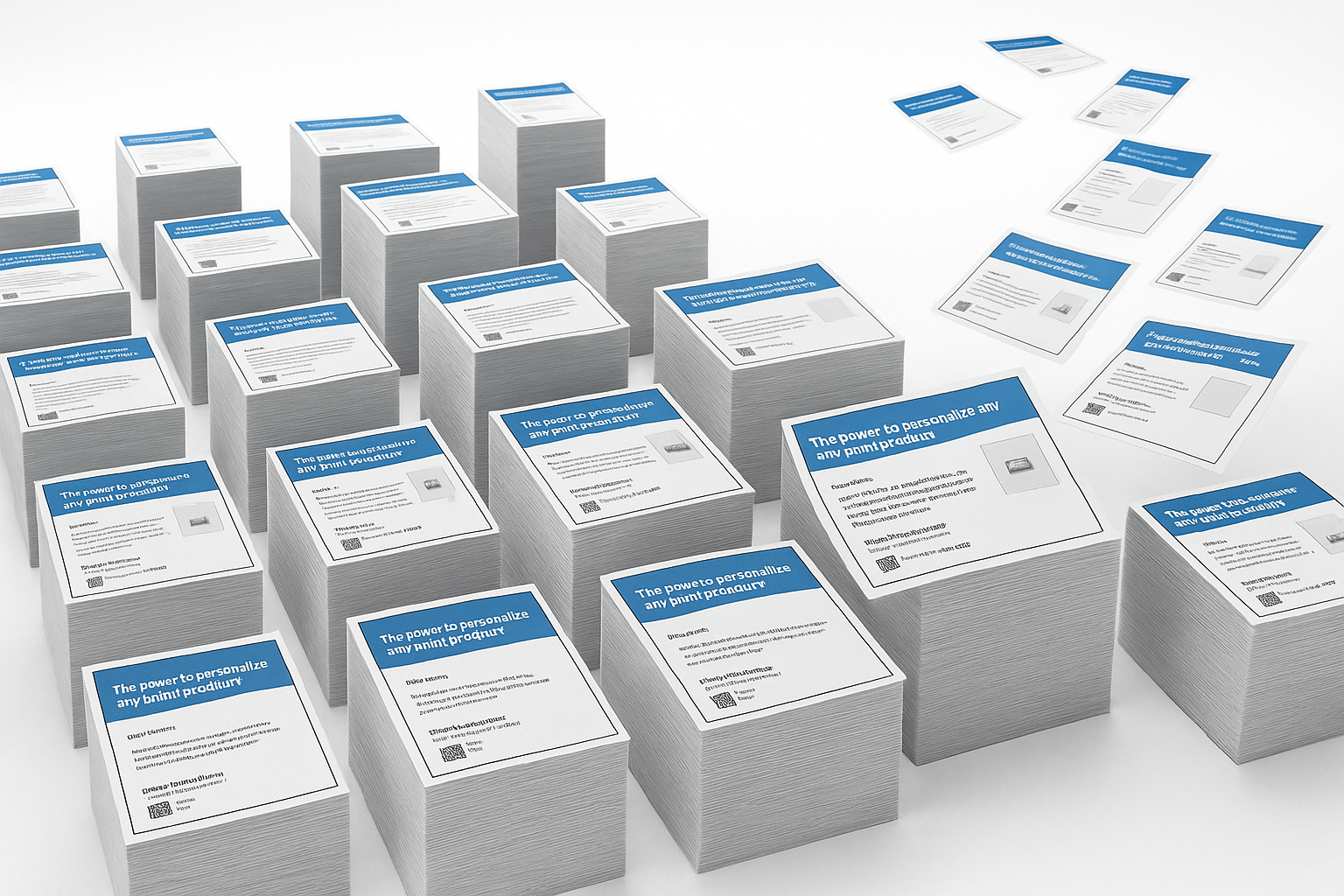
Campaign sizes increased. Users launched more mailings simultaneously. Daily output climbed from hundreds to thousands, and soon reached tens or even hundreds of thousands of personalized pages.
Suddenly, the questions changed:
- “How do we keep turnaround times predictable as volume grows?”
- “What happens during seasonal spikes or simultaneous campaigns?”
- “How do we scale without rewriting everything we’ve built?”
These weren’t signs of failure. They were signs of success. The system BrightReach originally built was working exactly as intended, until it was outgrown.
At this point, BrightReach reached out to the Customer’s Canvas team to explore how to strengthen the backend of their rapidly growing direct mail offering. Together, we identified the next logical step: migrating rendering to a scalable, distributed workflow designed specifically for high-volume, personalization-heavy production.
Building the Foundation for Scale
Scalable rendering addressed the challenges of growth without requiring a major redesign of the existing workflow. Instead, it improved performance behind the scenes.
- Rendering tasks distributed across dedicated nodes.
- Capacity scaled automatically during load spikes.
- Large campaigns no longer created bottlenecks.
- Turnaround time became predictable, often around the target two-hour window.
- Daily volumes of tens or even hundreds of thousands of personalized pages were processed reliably.
For BrightReach, this changed everything. They could continue signing up new customers, confident that production would keep pace. Their team didn’t need to micromanage workloads or delay campaigns during busy periods.
In other words, scalable rendering didn’t replace the original implementation. It unlocked the next stage of growth.
Conclusion: Choose a System That Supports Both Launch and Growth
Many teams begin their direct mail journey focused solely on the first step: giving users a way to personalize mailings. But the long-term success of the system depends on what happens later — when the platform grows, workloads increase, and performance becomes a business-critical requirement.
The story of BrightReach, a composite example representing many growing marketing platforms, illustrates a common path for businesses adopting personalized direct mail.
- Stage One: Build a polished, customer-facing personalization experience.
- Stage Two: Strengthen the production backend to support real growth.
Choosing a solution isn’t just about what gets you live. It’s about what keeps you growing.
By integrating Customer’s Canvas early and later expanding to scalable rendering, BrightReach built a direct mail engine that can evolve with their business — from the first personalized postcard to tens of thousands of unique mailers produced every day.
The real story behind any successful direct mail platform isn’t a single implementation. It’s the journey from idea to execution to scale.
If you’re planning the next step in your direct mail journey, we’re here to help. Contact us to discuss the right approach for your business.