Key Takeaways for 2026
- The Market is Mature: Direct mail is a thriving, multi-billion dollar industry. The conversation has shifted from "Does it work?" to "How easily can we execute it?"
- Digital Fatigue is Real: With digital Customer Acquisition Costs (CAC) up 222%, marketers are turning to the physical mailbox for its proven 112% average ROI.
- The "Canva Effect": Legacy "digital dropbox" portals are dead. Modern clients demand B2C-level self-service, intuitive visual VDP editors, and instant automated proofing.
- The Tech Mandate: To capture high-margin revenue, Print Service Providers (PSPs) must adopt Headless Web-to-Print architectures that enable touchless workflows, AI preflighting, and direct CRM integrations.
For years, tech headlines predicted the decline of physical print. Yet, a quick look at the Top-300 printing rankings in the US tells a completely different story: direct mail never went away. In fact, it has demonstrated consistent, resilient growth, with surveys valuing the global direct mail advertising market at over $70 billion.
As we navigate 2026, the direct mail industry is entering a new phase of maturity. The conversation among marketers is no longer about whether direct mail works, as the ROI is already proven. Instead, the focus has shifted entirely to how it is executed. Today's users are demanding a new level of service, digital-like convenience, and support for advanced omnichannel use cases.
When looking at the future of direct mail marketing, client expectations have permanently evolved. Here is why this shift is happening, and how Direct Mail Service Providers might consider upgrading their infrastructure to deliver this new standard of service.
The Proven Channel: Why Expectations Are Higher Than Ever
We have hit the "Digital Ceiling". Consumers are suffering from severe digital fatigue, overwhelmed by digital advertising, as over 42% of global internet users employ ad-blocking tools. Furthermore, Customer Acquisition Costs (CAC) in digital channels have skyrocketed. Research from SimplicityDX shows a 222% increase in digital CAC over the last decade due to privacy updates and the deprecation of third-party cookies.
In this noisy landscape, direct mail stands out as a premium, highly effective channel. When looking at the numbers, according to the ANA (Association of National Advertisers) Response Rate Report, direct mail delivers an impressive average ROI of 112%, consistently outpacing SMS and email. Furthermore, data confirms that a physical letter stays in the home for an average of 17 days, successfully leveraging the "endowment effect" of haptic marketing to create lasting brand impressions.
Because direct mail is now recognized as a high-value investment, marketers' expectations have skyrocketed. They no longer tolerate clunky processes. They expect the tools used to manage physical mail to be just as sophisticated and seamless as their digital marketing platforms.
Expanding Use Cases: Omnichannel and Triggered Mail
In its maturity phase, the industry has moved far beyond simple "batch and blast" campaigns. Marketers require their print partners to support complex, highly targeted use cases.
A modern direct mail strategy treats the mailbox as a synchronized channel within a larger digital ecosystem. Industry data reveals that clients who receive both email and physical mail spend 400% more than those who only receive email. Furthermore, the synergy of integrating direct mail with digital touchpoints can increase overall sales by 447%.
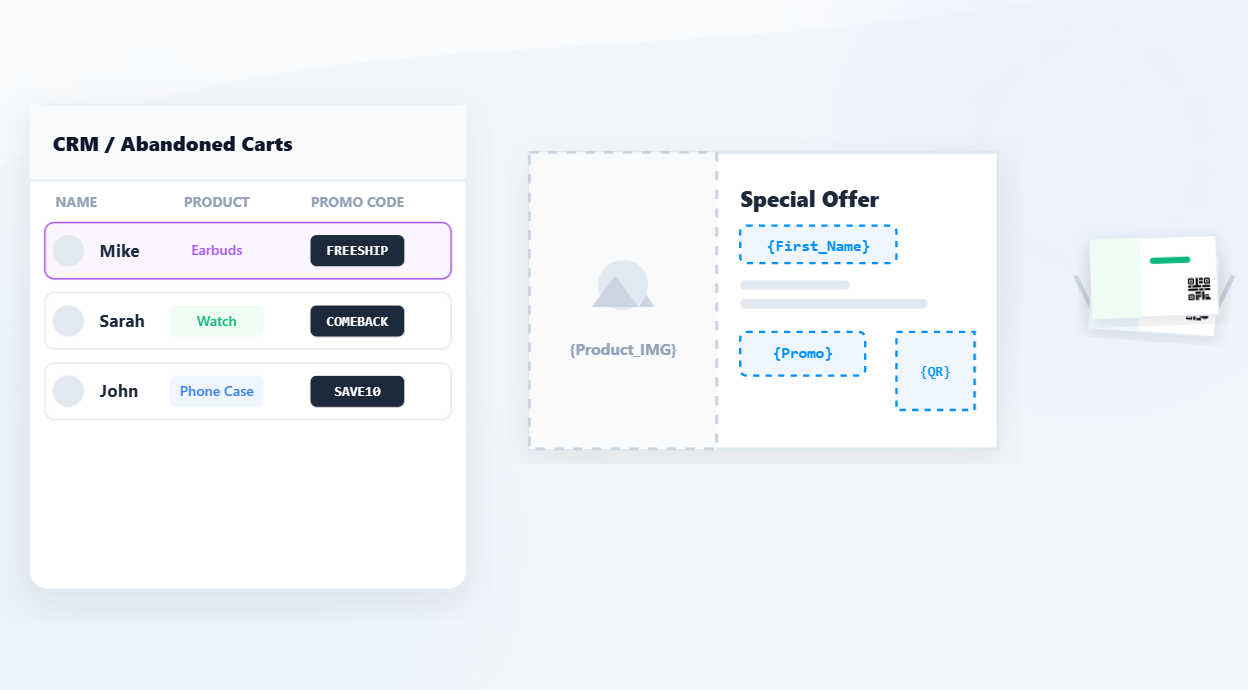
Marketers expect to run these omnichannel direct mail workflows effortlessly. For example, if a customer receives an email on Tuesday but does not open it, the system should automatically trigger a personalized postcard to land in their physical mailbox on Thursday. Supporting these advanced use cases requires print vendors to offer technology that seamlessly integrates with existing CRMs and marketing automation platforms.
The "Canva Effect" and the Illusion of Self-Service
The biggest shift in the mature direct mail market is how clients want to interact with their print providers. Today, many Print Service Providers will say, "We already have a client portal." However, a closer look often reveals the illusion of self-service.
In reality, most legacy print portals are just digital dropboxes. A marketer logs in, uploads a CSV file of addresses, and attaches a static PDF artwork. Behind the scenes, a prepress specialist still has to manually map the variable data fields, verify image resolutions, check bleeds, and generate a proof. This manual back-and-forth takes hours or even days and eats up massive amounts of hidden labor costs. Research confirms that prepress file preparation and proofing remain the absolute largest bottlenecks in print production.
This high-friction process completely clashes with modern expectations. Today's marketers are accustomed to the "Canva experience": instant visual feedback, drag-and-drop simplicity, and real-time execution. According to McKinsey, over 80% of B2B buyers now expect a B2C-level digital experience, demanding speed, transparency, and total autonomy. To provide this new level of true convenience, a modern Print Service Provider must offer a comprehensive client portal featuring:
- Intuitive VDP Editors: End-users need to visually customize Variable Data Printing (VDP) templates directly in their browser with real-time preview, eliminating the prepress mapping bottleneck.
- Brand Compliance: Corporate clients require "safety rails" (locked layouts, fixed fonts, protected logos) to ensure local franchisees or agents cannot compromise the brand identity.
- Instant Proofing and Automation: The system must instantly validate the data, perform automated preflight, and generate print-ready PDFs the moment the user clicks "Approve," sending the file directly to the production floor with zero manual touchpoints.
Building the Infrastructure for the Future
To capture the high-margin revenue of 2026 and meet these mature market demands, PSPs must evolve from simple print manufacturers into true Marketing Service Providers. You already have the heavy iron, including the presses, the finishing equipment, and the logistics. What you need is the digital front-end.
Instead of replacing your entire MIS or production workflow, the smartest approach is to adopt a Headless Web-to-Print architecture. Solutions like Customer's Canvas allow you to embed powerful VDP editors and order-intake portals directly into your existing tech stack. This turns your legacy "digital dropbox" into a modern, touchless self-service portal, satisfying your clients while standardizing the files your production team receives.
| Feature | Growth Phase (Past) | Maturity Phase (2026 & Beyond) |
|---|---|---|
| Strategy | Standalone "Batch and Blast" | Integrated Omnichannel Touchpoint |
| Client Experience | Legacy Portals (Digital Dropboxes) | True Self-Service (The "Canva Experience") |
| Prepress | Manual data mapping & proofs | Touchless, instant automated proofing |
| Use Cases | Broad targeting, basic data | Behavioral triggers, hyper-personalization |
| Design Control | Professional graphic designers | End-users via restricted online editors |
Worth Mentioning: Emerging Trends in 2026
To stay truly competitive in the mature direct mail market, forward-thinking PSPs are already aligning their technology with these three major trends:
- Sustainability and Eco-Friendly Print: Sustainability is no longer a bonus; it is a corporate requirement. Brands actively request printing on recycled paper and carbon footprint tracking. Modern Web-to-Print portals allow users to automatically select "green" materials and calculate the eco-metrics of their campaigns right at the checkout.
- AI in Prepress Automation: Artificial Intelligence has moved beyond writing marketing copy. Leading PSPs are combining Headless Web-to-Print with AI to automatically fix uploaded client files. This includes automatically adding bleeds, upscaling image resolution, and performing smart preflighting, which further eliminates manual labor from the equation.
- USPS Promotions and Technological Formats: To offset rising postal rates, marketers are embedding complex technologies like custom QR codes, NFC tags, and Augmented Reality (AR) into their mailers. Doing so can secure USPS postage discounts ranging from 3% to 5%. Your underlying platform must easily generate and map these advanced VDP elements at scale.
By upgrading your digital infrastructure to support true self-service, complex use cases, and seamless integration, you position your business to become an indispensable partner in the mature direct mail market.
As digital channels become saturated and privacy regulations limit online tracking, direct mail offers a tangible, highly targeted alternative. Because mature direct mail strategies rely on specific behavioral triggers and rich variable data (VDP), the relevance, and therefore the response rate (averaging 112% ROI), is significantly higher than legacy batch mail.
Marketers are moving away from disconnected mass mailings. They are demanding support for omnichannel workflows and smart direct mail campaigns by using CRM data to automatically trigger highly personalized, physical touchpoints based on user behavior (e.g., abandoned cart mailers or post-purchase follow-ups).
Yes. An efficient hybrid direct mail operation does not actually print one piece at a time. A unified front-end receives continuous triggers throughout the day and standardizes the files into a hot folder. Your production workflow software then aggregates these files for automated small-batch printing to maximize paper usage and press time.
Print providers need a unified digital front-end that delivers a B2C-like user experience. This includes an embeddable Web-to-Print editor for variable data templates, robust brand compliance tools, and API integrations that connect the client's CRM directly to the provider's production queue for a completely touchless workflow.