Just a few years ago, the print market was strictly segmented: commercial printers handled brochures, packaging shops made folding cartons, and sign shops printed banners. Today, as we highlighted in our overview of the Top Print Industry Trends of 2026, those boundaries have completely collapsed according to the PRINTING United Alliance Profiting Through Convergence report.
This industry-wide shift is known as convergence, and it has become the primary growth engine for the modern print business. The data is compelling: 73% of commercial printers have already expanded into new segments like labels, promotional products, or apparel. More importantly, those who successfully diversify see an average revenue increase of 16.7% and a profitability boost of 11.1%. Print buyers increasingly demand a "one-stop shop," and PSPs are rapidly evolving into multi-service hubs to capture that high-margin revenue.
However, there is a catch. Most printers treat this shift purely as a hardware investment: buy the label press, capture the label revenue. But as you begin to scale, you quickly discover that the real friction doesn't happen on the production floor. It happens within your IT ecosystem.
The Hidden Cost of the "Quick Win"
When sales teams secure a new product category, the immediate reflex is to procure a specialized software tool to sell it. If you need to sell folding cartons, you buy a packaging portal. If you are launching photo books, you license a dedicated designer app.
While bolting on a new storefront feels like a quick win, it quietly introduces crippling operational debt. Let's look at the day-to-day reality of managing just three different product portals:
- Administrative Overhead: Your customer service representatives (CSRs) and accounting teams now have to monitor multiple admin panels, juggling different login credentials and struggling to consolidate invoices from disconnected systems.
- Data Silos: Your marketing team loses sight of the customer journey. A B2B client might buy business cards in one portal and banners in another, but your CRM treats them as two separate entities because the storefronts don't talk to each other.
- Prepress Inefficiency: Your prepress department is forced to learn multiple distinct interfaces just to retrieve files. Each system has its own quirks, naming conventions, and export formats, adding minutes of non-billable administrative work to every single job.
Every new tool demands its own manual workarounds, fragmenting your customer data, isolating user accounts, and disconnecting your prepress workflows. The more product types you say "yes" to under this fragmented model, the more you dilute your operational efficiency. What started as a promising new revenue stream quickly devolves into an administrative nightmare.

The True Bottleneck of Expansion
This reveals a fundamental truth about modern expansion: convergence creates a system problem, not a production problem.
Your digital presses are inherently versatile. A modern digital press can shift from running commercial brochures to printing short-run folding cartons in a matter of minutes. The press hardware and the DFE simply need a valid, print-ready PDF to do their job.
Your Web-to-Print software, however, is a completely different story. Traditional W2P platforms are rigidly built around a singular product logic, making them incredibly fragile when exposed to new product categories. Consider the extreme structural differences in how products are sold and processed:
- Commercial Print: Relies on simple, fixed-size 2D templates with standard text-based variable data fields.
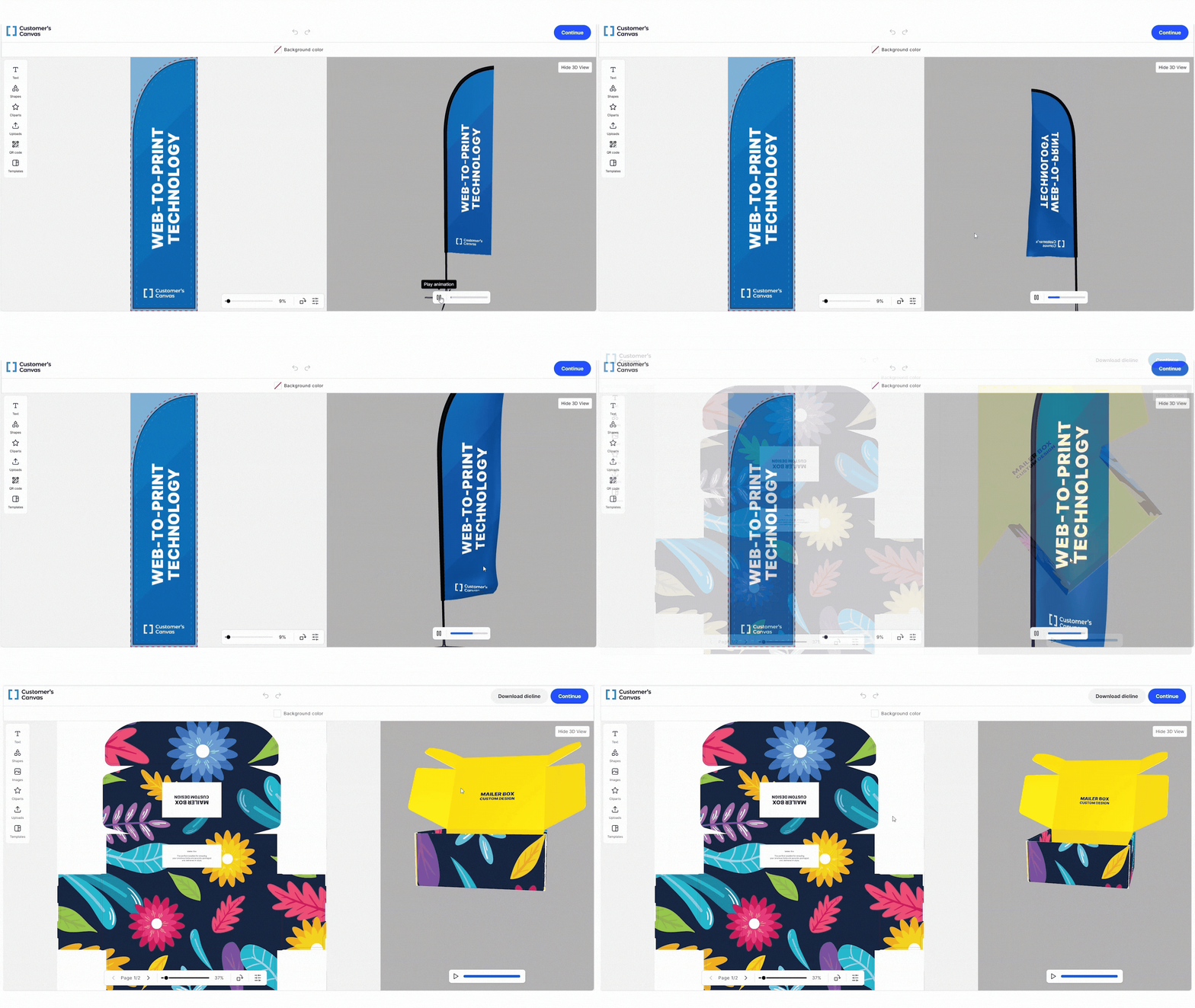
- Packaging & Labels: Requires complex 3D visualization, structural CAD data, precise die-line generation, and overlapping mask layers for premium embellishments and spot colors.
- Wide-Format & Signage: Demands dynamic, dimension-based pricing (by square foot), custom finishing options (grommets, hemming), and the ability to process massive, high-resolution files.
When you attempt to force these highly variable products through specialized, disconnected storefronts (or try to "hack" a business card portal to sell packaging) the system breaks. Order processing stalls, pricing logic fails, and prepress teams are forced to manually intervene on every job. You aren't actually scaling your business; you are simply multiplying your points of failure and suffocating your production floor.
Why the "Software Zoo" Breaks Your Business
Building a "Software Zoo" - a collection of disconnected, boxed solutions - inevitably leads to three critical roadblocks that stifle true growth:
- The Integration Wall: Each standalone tool requires its own bridge to your MIS or ERP. Maintaining five different integrations is five times more expensive and exponentially more prone to errors.
- The Fragmented Customer Experience: Your B2B buyers refuse to juggle five different logins for five distinct product lines. If they cannot order their signage, labels, and corporate stationery within one unified environment, they will find a competitor who offers a seamless experience.
- Prepress Chaos: Multiple intake systems generate multiple file standards. This forces your prepress team to manually normalize every file from different sources before it ever hits the RIP, completely destroying the margins on short-run jobs.
Traditional storefronts fail at scale because they were designed exclusively for selling a specific product, not for managing the complex data flow of a multi-segment production environment.
Infrastructure, Not More Tools
The takeaway is clear: succeeding in an era of convergence requires foundational infrastructure, not a longer list of niche tools.
The objective is not to buy a separate "packaging tool" and a "signage tool." The goal is to deploy a unified graphics infrastructure that standardizes order intake, normalizes diverse file formats, and acts as an intelligent bridge between the client's browser and your production floor.
Building Your Infrastructure with Customer’s Canvas
This is the exact purpose of the Customer’s Canvas Hub. Rather than selling you another isolated storefront, we provide the control layer that makes true convergence profitable.
By acting as a centralized engine, our platform empowers you to build a single, unified ordering interface for your clients. Whether processing a simple business card or a complex embellished package, the underlying architecture handles the data identically, guaranteeing a touchless transition from a web order to a press-ready file every single time.
Stop adding tools. Start building your infrastructure.
Book a demo to see how Customer’s Canvas can help unify your workflow.
Contact Us