The transition to digital printing is no longer a "future trend": it’s the reality we've been living in for years. As we explored in our overview of the Top Print Industry Trends of 2026, the market demands technology options: 48% of print buyers strongly prefer working with providers who offer dedicated digital printing, and 45% strongly prefer a hybrid of both digital and offset capabilities.
You’ve likely already invested heavily in modern digital presses to keep up with these buyers who demand faster turnarounds and smaller, highly personalized runs. But here is the hidden problem: owning the fastest digital press doesn't guarantee profitability. In fact, many Print Service Providers (PSPs) are finding that taking on more digital jobs is secretly destroying their margins.
To understand why this is happening, let's look back at the "golden era" of traditional offset. A print buyer submits a PO for 50,000 web-printed catalogs with static artwork. Sure, plating and makeready took time and materials. But amortized over a massive run length, the cost of an operator manually preflighting and prepping that file was a rounding error: usually less than 0.5% of the total job ticket.
Fast forward to today. The digital revolution is complete. According to the PRINTING United Alliance Digital Packaging: Maximizing Innovation and Impact survey, print buyers now expect a highly agile digital approach as the absolute baseline:
- 51% are looking for cost-effective short runs;
- 44% demand faster time-to-market;
- 30% want quicker design changes and versioning.
The True Bottleneck: An Intake, Not a Printing
When margins shrink on short runs, business owners often look for inefficiencies on the production floor. But just like the convergence trap we recently analyzed, this reveals a fundamental truth about modern scalability: managing short runs is a system problem, not a production problem.
Your digital presses are doing exactly what they were built to do: printing a batch of 500 premium labels or 100 business cards in minutes. The bottleneck occurs long before the job hits the RIP.
The problem is that you are trying to feed a high-speed digital press using a manual file intake process built for the offset era. Digital printing makes a $50 invoice common, but to get that $50 job onto the press, your team is performing the exact same number of manual "touchpoints" as they would for a $5,000 offset catalog.
Why Manual File Handling Breaks Your Business
The math of short runs completely breaks down the moment human intervention is required. Let's look at the three critical roadblocks where manual artwork processing destroys your margins:
- Ingestion Trap: Clients supply garbage native files. No bleeds, missing linked assets, RGB images buried inside a PDF, or unembedded fonts. Your file prep specialist has to crack open the file, flag the issues, and bounce it back to the customer service representative, who then chases the client. It’s a 30-minute manual loop for a single micro-order. At this point, the true cost of file handling jumps from 0.5% to 30-40% of the job ticket.
- Endless Proofing Loop: Your operator fixes the bleeds and emails a soft proof. The client requests a "quick text change." The operator makes the edit and sends V2. At $30–$50 an hour for a skilled prep specialist, just two rounds of manual email revisions will completely wipe out the profit on a short-run digital job.
- Normalization Chaos: To prevent registration nightmares or color shifts, someone still has to manually convert RGB to CMYK, flatten complex transparencies, and map rich blacks. Jobs pile up in the file prep queue, starving your digital presses of work and killing your daily throughput.
The problem has become so severe that some PSPs are instituting a "Canva tax": slapping a manual file-fixing fee onto the invoice when a customer uploads bad DIY artwork. But penalizing your buyers creates friction and drives them straight to competitors who offer a seamless ordering experience.
Infrastructure for a Touchless Workflow
The takeaway is clear: the only way to break this vicious cycle and make short runs truly profitable is to eliminate manual file touchpoints entirely. Processing routine digital orders should take exactly zero minutes of your employees' time.
This requires shifting from manual file fixing to an automated artwork infrastructure. The goal is a hands-off file ingestion engine that shifts the burden of artwork preparation onto the customer themselves, but does it so elegantly that the customer doesn't even notice.
Automating File Prep with Customer’s Canvas
At Customer’s Canvas, we understand that for digital printing, file velocity is just as important as press speed. Our platform acts as your tireless, automated file-handling engine, sitting right between your storefront and your production floor:
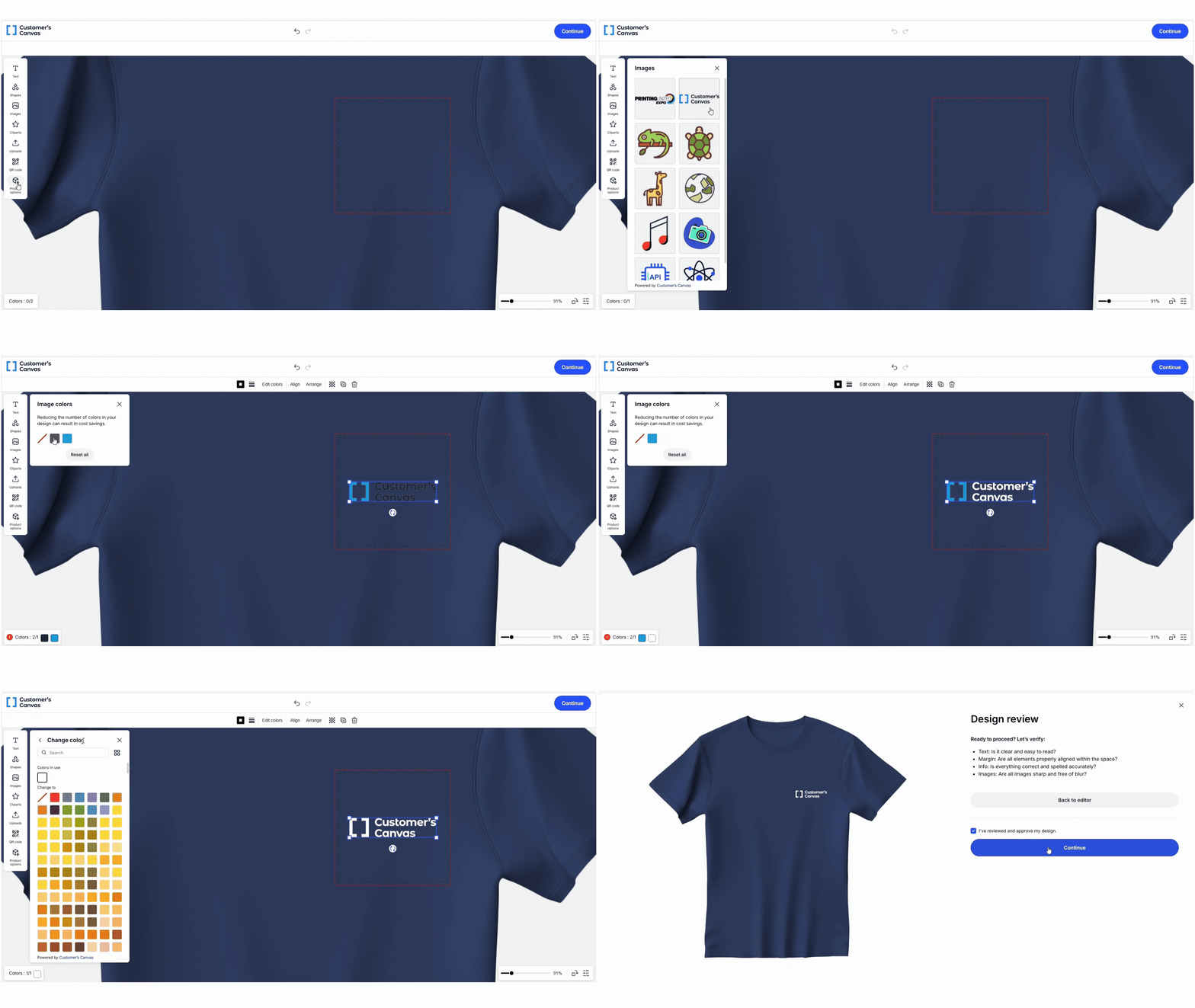
- Pre-emptive Validation: Customer's Canvas acts as a strict gatekeeper. Users edit templates or upload designs directly in the browser. The system warns them immediately if an image is low-res or text spills outside the safe zone. Bad files simply cannot enter your workflow.
- WYSIWYG Self-Approval: The customer edits and proofs their own artwork in real-time. When they hit "Order," the proof is automatically approved by the buyer. Zero back-and-forth emails required.
- Bulletproof PDF/X Generation: As soon as the order is placed, the system automatically normalizes the artwork and generates a flattened, print-ready PDF file (complete with crop marks, correct CMYK profiles, and proper overprints) directly to your DFE via API.
Your highly skilled operators can finally exhale and focus on complex, high-value tasks instead of routinely fixing someone else's business cards.
Let us show you how to cut artwork touchpoints down to zero and make digital printing your main profit driver.
Contact Us