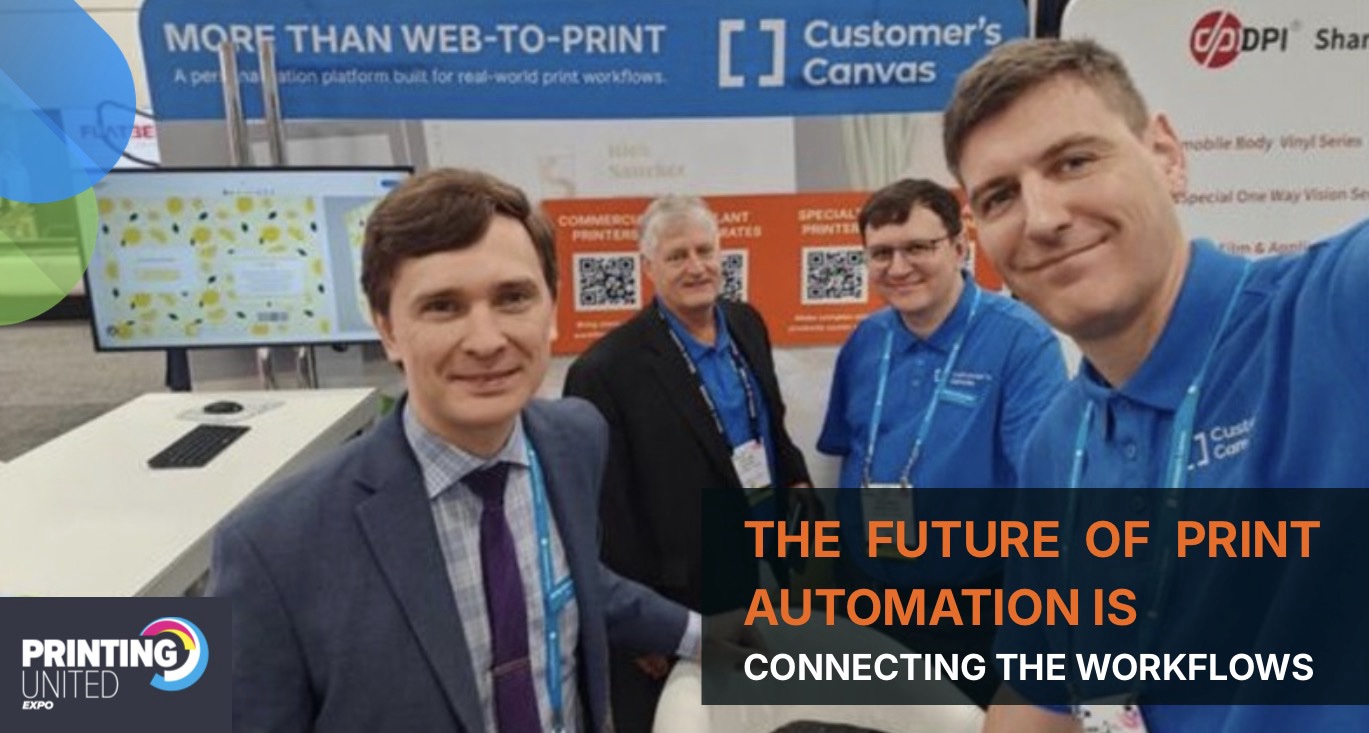
PRINTING UNITED is always a useful place to see where the print industry is actually moving.
Not just which technologies are getting attention, but which business problems keep appearing across commercial print, wide format, direct mail, promotional products, and other parts of the market.
This year, one theme stood out more than anything else: print businesses are becoming more diverse, while the workflows behind them are becoming harder to manage.
That matters because the industry is already operating under significant economic pressure.
According to data presented during an industry outlook session at PRINTING UNITED, 73.7% of respondents said their pre-tax profitability had either declined or remained flat. At the same time, 31.7% had reduced or postponed capital spending.
Customers, meanwhile, continue to expect faster turnaround, more choice, smaller runs, and competitive pricing.
Print providers are being asked to do more without allowing cost and complexity to grow at the same pace.
Diversification is creating a new kind of complexity
Diversification remains one of the clearest ways print providers are responding to market pressure.
Data presented at the show indicated that 71.1% of print businesses have expanded beyond their original areas of specialization.
That is easy to recognize across the industry. Commercial printers add wide-format products. Sign companies move into promotional items. Direct mail providers build digital ordering experiences. Personalized products continue to spread into new categories.
This creates new revenue opportunities, but every new product category also introduces its own operational rules.
A business card, a banner, a direct mail campaign, and a personalized promotional product may all be sold online, but the workflows behind them can be completely different.
- Product configuration may be different.
- Artwork requirements may be different.
- Approval processes may be different.
- Pricing logic may be different.
- Production and fulfillment requirements may be different.
Adding another product to a catalog is relatively easy.
Building an efficient workflow around it is much harder.
If every new product introduces another manual process, diversification can add operational cost almost as quickly as it adds revenue.
The important question is therefore changing.
It is no longer simply:
How do we put more products online?
It is increasingly:
How do we support more types of work without creating more operational overhead?
Automation still has a long way to go
The print industry has already automated many individual tasks, but the data presented at PRINTING UNITED also showed how much work remains.
Only around 4% of respondents described their operations as fully automated. Another 51% reported automation in individual parts of the workflow rather than across the operation as a whole.
That distinction is important.
A print business may already have ecommerce, preflight software, an MIS, production automation, shipping software, and customer databases.
It can still depend on people to move information between those systems.
That is where much of the remaining inefficiency lives.
The next stage of print automation is therefore unlikely to come from simply adding more isolated tools. It will come from connecting workflows.
Web-to-Print is becoming workflow infrastructure
Web-to-Print is not going away.
If anything, it is becoming more important. But the job it has to perform is expanding.
The traditional model is relatively straightforward: a customer selects a product, personalizes a template or uploads artwork, places an order, and the job moves into production.
That works extremely well for predictable products.
But as print providers diversify, more jobs fall outside that simple model.
Some require additional information. Others need help from a salesperson or customer service representative. Artwork may need to be corrected. Specifications may change. Several people may need to review or approve the job before it reaches production.
For those orders, a storefront alone is not enough.
The digital experience has to support what happens between the initial request and the production-ready order.
That pushes Web-to-Print into a broader set of workflows:
- collaborative ordering;
- artwork intake;
- approvals;
- brand management;
- workflow automation;
- system integrations.
The storefront remains important. It is simply becoming one part of a larger workflow.
The difficult orders are the next automation opportunity
The easiest print jobs were also the easiest ones to put online.
Much of that work has already been done.
The next opportunity lies in the jobs that still fall back to email, phone calls, spreadsheets, shared folders, and manual intervention.
These are often jobs involving unusual specifications, several stakeholders, customer-supplied artwork, multiple approval stages, custom pricing, production constraints, or exceptions that cannot be represented by a simple form.
There is a temptation to solve this by adding more fields to the storefront.
But complexity cannot always be reduced to a longer checkout form.
Sometimes the workflow itself needs to become collaborative.
A customer may initiate the order. A salesperson may refine it. A designer may prepare or adjust artwork. Another stakeholder may approve it.
In those cases, digital ordering should reflect how the work actually happens rather than forcing every job through the same linear path.
This may be one of the biggest opportunities for the next generation of Web-to-Print.
Artwork intake remains a major source of manual work
Some of the most persistent workflow problems in print are also some of the oldest.
Customer artwork is a good example.
Files still arrive with insufficient resolution, missing bleed, incorrect dimensions, font problems, unexpected PDF settings, or other issues that make them unsuitable for production.
Someone has to deal with those problems before the job can move forward.
For many print providers, that still means manual inspection and another round of communication with the customer.
This makes artwork intake an unusually broad automation opportunity.
Modern systems can increasingly detect issues immediately, explain them to the customer, and in some cases correct them automatically.
That changes the role of preflight.
Instead of happening only after an order has entered production, it can become part of the ordering experience itself.
The earlier a problem is identified, the less expensive it is to resolve. If common issues can be repaired automatically, an entire category of repetitive work can be removed from the workflow.
AI becomes more useful when it removes a manual touch
AI was everywhere at PRINTING UNITED, as expected.
But some of the most useful applications in print may turn out to be less spectacular than the most visible demonstrations.
The strongest business case for AI is often simple: reduce repetitive work.
That can mean:
- preparing artwork;
- creating design variations;
- adapting existing designs;
- improving customer-supplied images;
- identifying production problems;
- generating and maintaining templates;
- helping employees prepare jobs faster.
AI does not need to replace an entire creative process to produce economic value.
Saving several minutes from a task that happens thousands of times can matter more than generating one impressive design.
For print businesses, a useful test may therefore be:
Does this remove a manual touch, reduce setup time, or prevent production work later?
If it does, the value becomes much easier to measure.
Some of the best uses of AI may happen behind the storefront
Much of the current conversation around generative AI assumes that the end customer will describe what they want and have AI create the design.
That is certainly one possible use case.
But B2B print has another large body of repetitive creative work.
When a new corporate customer is onboarded, someone may need to prepare branded templates, multiple formats, design variations, approved assets, and layouts for different products.
Those libraries then have to be maintained over time.
AI that helps a print provider create and manage that content more efficiently may ultimately create more value than asking every customer to become an AI designer.
Some of the most useful AI in print may therefore be almost invisible to the end customer.
Brand management is another hidden workflow
Corporate print programs introduce another layer of complexity.
Printers serving multiple organizations may need to manage logos, colors, fonts, templates, brand guidelines, and approved assets.
Individually, none of these tasks looks particularly difficult.
At scale, they create substantial repetitive work.
This is another example of how the boundaries of Web-to-Print are expanding.
A corporate ordering portal is not simply a place where employees choose products. It can also become the system that controls which assets and templates are available, how they can be changed, and how the organization maintains brand consistency across locations and users.
Integration is becoming part of the product
Print businesses rarely operate around one application.
An order may need to connect to:
- ecommerce;
- MIS or ERP;
- payments;
- shipping;
- postal systems;
- preflight;
- production;
- fulfillment.
As more of the workflow becomes automated, those connections matter more.
A system can have an excellent user interface and still create manual work if an employee has to copy information into another application after every order.
That is why integration is becoming more than an implementation detail.
It is increasingly part of the customer experience.
The best digital workflow is not necessarily the one with the longest feature list. It is the one that allows information to move through the business with the least friction.
Automation is moving from individual steps to connected workflows
Taken together, the economic data and the conversations around PRINTING UNITED point in the same direction.
Print providers are under pressure to become more efficient.
They are diversifying to find new sources of growth.
But most have not yet achieved end-to-end automation.
That combination creates the next challenge for print technology.
The industry already has strong tools for ecommerce, design, preflight, estimating, production, shipping, and fulfillment.
The bigger opportunity now is making those pieces work together.
A more automated print workflow should allow:
- customers to begin orders digitally;
- complex jobs to develop collaboratively;
- artwork to be checked before it reaches production;
- repetitive work to be assisted by AI;
- brand rules to travel with the order;
- information to move between systems automatically;
- exceptions to be handled without breaking the entire process.
That is a much broader vision than traditional Web-to-Print.
Web-to-Print is getting a bigger job
The clearest takeaway from PRINTING UNITED 2026 is not that printers need more technology.
They already have plenty of technology.
The challenge is making that technology work together as the business becomes more complex.
With profitability under pressure, investment being scrutinized, and diversification continuing across the industry, automation has to do more than add features.
It has to improve throughput.
It has to reduce manual touches.
And it has to make complexity easier to manage.
The next phase of Web-to-Print will therefore not simply be about getting another product online.
It will be about connecting the entire journey from customer intent to production.
Web-to-Print is not disappearing. It is becoming a much bigger job.
Explore Customer's Canvas