The customer interface is changing. Is your print infrastructure ready?
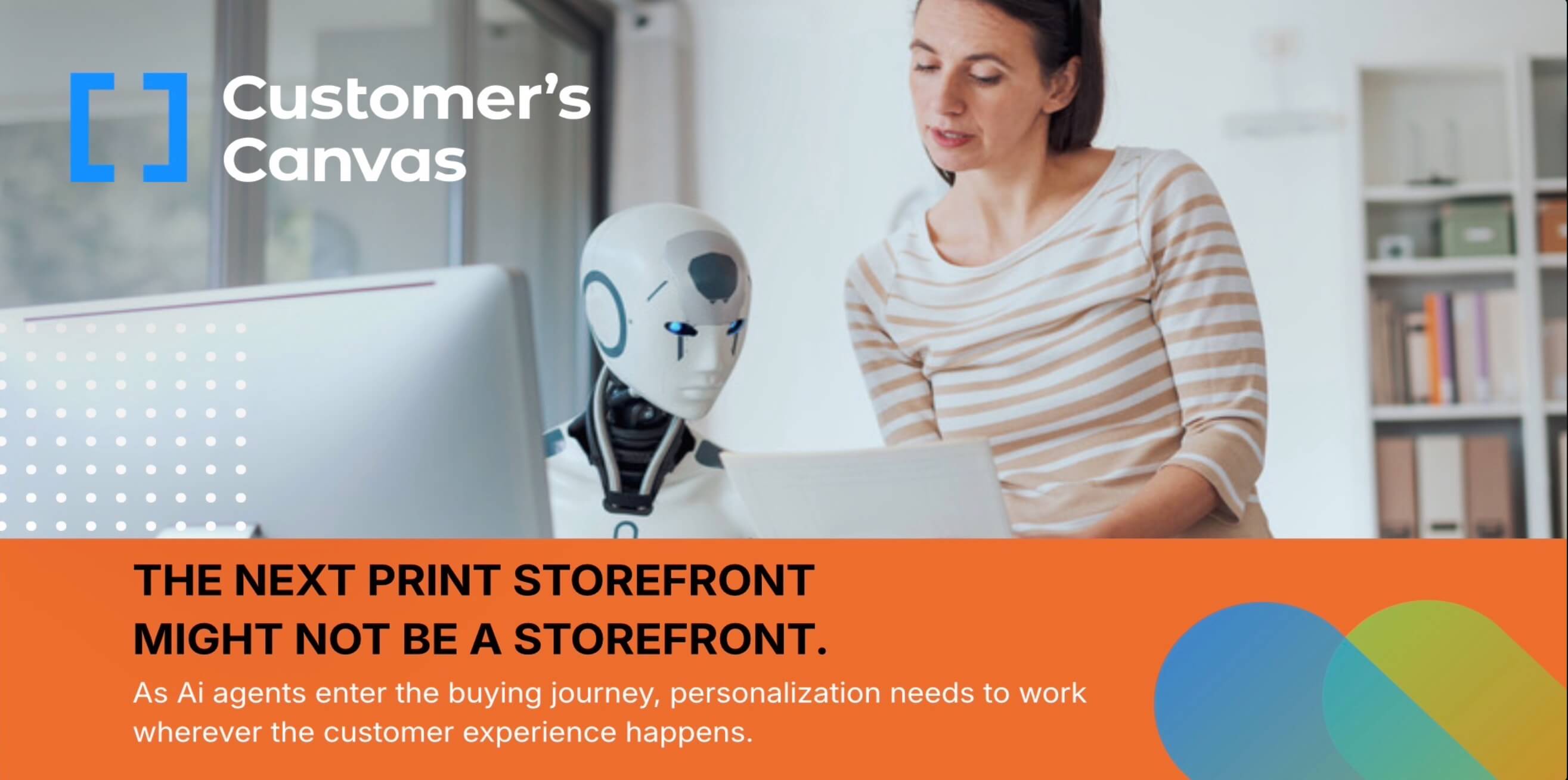
What happens when your customer's next print buyer isn't a person visiting your website, emailing a customer service representative, or requesting a quote?What if it's an Ai agent?
That's the question raised by a recent Printing Impressions article, "Will AI Agents Start Buying Print for Your Customers?" The article explores how Ai agents could move beyond answering questions and recommendations to searching for products, comparing suppliers, evaluating pricing, and eventually taking action on a buyer's behalf.
We're not suggesting that autonomous Ai agents are about to replace print buyers. But the direction of travel matters.
Because if the way customers discover, configure, and purchase print changes, the technology underneath that transaction needs to be ready for it.
From storefront to infrastructure
For years, the digital print commerce journey has looked something like this:
Human → storefront → online editor → order
A customer finds a printer, visits a web-to-print storefront, configures a product, personalizes the artwork, approves it, and places the order.
That model isn't disappearing. For many print businesses, the storefront will remain an important customer interface. But it is increasingly likely to become one of several possible entry points into the print commerce infrastructure.
The emerging model could look very different:
Human → Ai agent → APIs → personalization and production infrastructure → order
Or:
Marketing platform → personalization infrastructure → production → fulfillment
Or:
E-commerce application → product configuration → personalization → production
The common factor isn't the interface. It's the infrastructure underneath it.
The print product still needs to be configured correctly. The artwork still needs to be personalized. Files still need to be rendered and validated. Production specifications still need to be respected. And the order still needs to reach the right systems.
That is where the infrastructure becomes important.
Print is not a simple SKU
One reason print presents an interesting challenge for agentic commerce is that print products are rarely as simple as selecting a product and clicking "buy."
A print order can involve:
- Finished size
- Quantity
- Paper stock
- Color and printing process
- Coatings and finishing
- Binding
- Personalization
- Artwork requirements
- Mailing and fulfillment
- Delivery destinations
- Production and turnaround requirements
An Ai agent therefore needs more than a product name and a price. It needs access to structured information about what can be produced, how it can be configured, what rules apply, and what happens after the order is placed.
This is one of the points made in the Printing Impressions article: printers that make their products, capabilities, specifications, pricing, and turnaround information easier for software to interpret could be better positioned as Ai-assisted procurement develops.
That has implications far beyond Ai.
It is another reason why digital transformation in print shouldn't be reduced to simply having a web-to-print storefront.
H2: Personalization is becoming a capability, not a destination
Historically, personalization has often been something a customer visits.They go to a storefront. They open an editor. They upload or select content. They make changes. They approve the result.
But personalization is increasingly becoming a capability that can sit behind many different applications and workflows.
A franchise network might use it to automatically generate localized marketing materials for individual locations. A marketing platform might use it to generate personalized direct mail at scale. An e-commerce application could use it to create customized products based on customer data. An automated workflow could generate production-ready artwork without anyone opening a design editor at all.
In each case, the customer may never interact directly with the personalization technology.
The important capability is what happens behind the scenes: customer data, business rules, and product specifications are transformed into correctly configured, production-ready artwork.
This means personalization is less of a destination and more of an infrastructure capability that can be embedded wherever the customer journey happens.
What does an Ai agent actually need?
For an Ai agent to participate meaningfully in print commerce, the technology behind the transaction needs to be understandable and accessible to software.That means moving beyond information buried in PDFs, emails, static web pages, or manual processes.
It means exposing capabilities through things such as:
Structured product data
Products, formats, materials, quantities, finishing options, and production capabilities need to be clearly defined.
Configuration rules
The system needs to understand which combinations of options are possible - and which aren't.
APIs
Applications and agents need a reliable way to communicate with personalization, product configuration, pricing, ordering, and production systems.
Personalization infrastructure
Customer data needs to be translated into correctly configured, production-ready artwork.
Automated rendering and validation
The resulting files need to meet the technical requirements of the production environment without relying on manual intervention at every stage.
Connected workflows
The transaction needs to move from configuration to production without creating another disconnected process for the print operation.
None of these capabilities are exclusively about Ai.
In fact, that's the point.
Build for the interface you have - and the ones you don't
The smartest response to agentic commerce isn't necessarily to start building an Ai shopping agent.
It's to make sure your print commerce infrastructure can support whatever interface comes next.
Customers may continue to use traditional web-to-print storefronts.
They may increasingly buy through e-commerce platforms.
They may interact with marketing applications that trigger print automatically.
And some may eventually ask an Ai agent to handle the process for them.
The front end can change without requiring the entire print technology stack to be rebuilt.
That's the advantage of treating personalization and production capabilities as infrastructure rather than as a destination.
Where Customer's Canvas fits
This is the model Customer's Canvas is built for.The Hub provides API-first personalization infrastructure that can sit behind different customer experiences - whether that's a traditional web-to-print storefront, an e-commerce application, a marketing platform, an enterprise workflow, or an Ai-driven interface.
Instead of making personalization another destination a customer has to visit, it provides the capabilities that other applications can call upon.
That includes:
- Product and template configuration
- Personalization rules
- Automated artwork generation
- Rendering and output
- Production-aware validation
- API-based integration with other systems
That distinction could become increasingly important as Ai changes how customers interact with commerce.
The real question isn't whether Ai will buy print
It's tempting to focus on the headline question:
Will Ai agents start buying print?
Maybe.
The more useful question for printers is:
If they do, will your systems be ready to sell to them?
You don't need to predict exactly how customers will purchase print five years from now.
You need to build an architecture that can accommodate change.
Because the next generation of print commerce may not begin at the storefront.
The storefront will remain one interface. Ai agents, e-commerce platforms, marketing applications, and enterprise workflows may become others.
The businesses that are prepared for that shift will be the ones that have separated the customer interface from the personalization and production infrastructure underneath it.
Personalization doesn't have to be where the customer goes. It can be what makes wherever they go work.
Customer's Canvas provides the personalization infrastructure to make that possible.